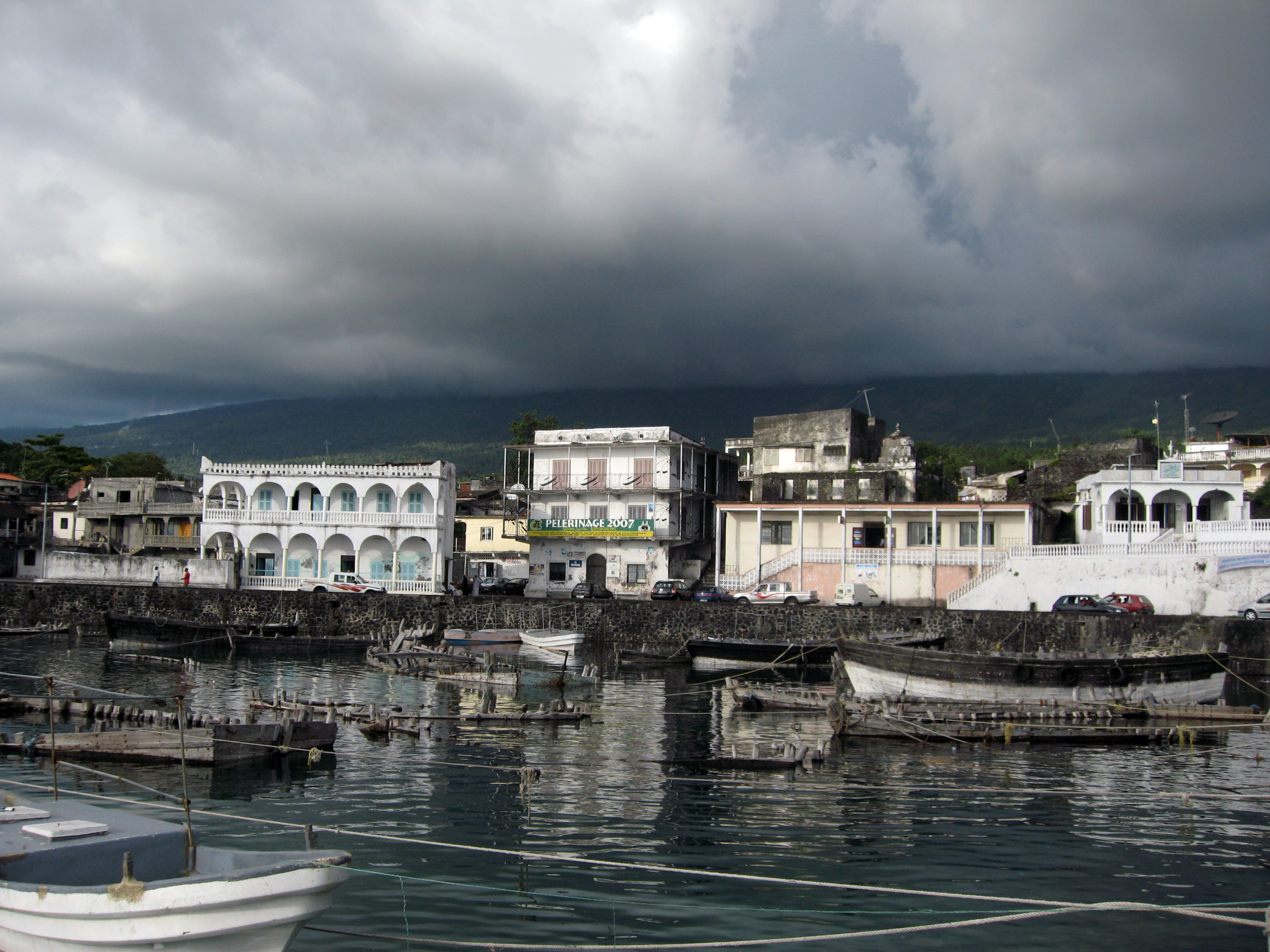
The name Moroni comes from the Comorian language (Shikomori) word mroni, meaning 'at the river.' Despite being a coastal city, the name refers to the seasonal streams and watercourses that flow from the slopes of the nearby Mount Karthala volcano down to the sea. These freshwater sources were essential for the early settlers who founded the site around the 10th century CE.
Moroni’s history is rooted in the Swahili-Arab trade networks of the Indian Ocean. It was established as a trading post by Arab and Persian (Shirazi) merchants who intermarried with Bantu populations from mainland Africa. For centuries, the city served as the seat of the Sultanate of Bambao, one of the many rival Islamic states that governed the archipelago. The city's architecture, particularly the Old Friday Mosque (Ancienne Mosquée de Vendredi), reflects this deep Islamic heritage and its historic ties to the Swahili Coast.
France began exerting influence in the 19th century and formally colonized the islands in the early 20th century. Moroni replaced Dzaoudzi (on Mayotte) as the administrative capital of the territory in 1958. When the Comoros gained independence on July 6, 1975, Moroni remained the capital of the new republic. The city is set against the dramatic backdrop of Mount Karthala, one of the world's most active shield volcanoes, which frequently reshapes the surrounding landscape with its eruptions.
Today, Moroni is a quiet yet culturally rich capital, characterized by narrow winding alleys in its ancient Medina, bustling spice markets, and the scent of ylang-ylang and cloves. It serves as the political and economic heart of the Union of the Comoros, bridging the nation's traditional sultanate history with its modern role as an independent Indian Ocean state.