The Complete Guide to Demonyms: Everything You Need to Know
Discover everything about demonyms - what they are, how they're formed, why they matter, and how to use them correctly. Complete guide with 100+ examples and expert insights.
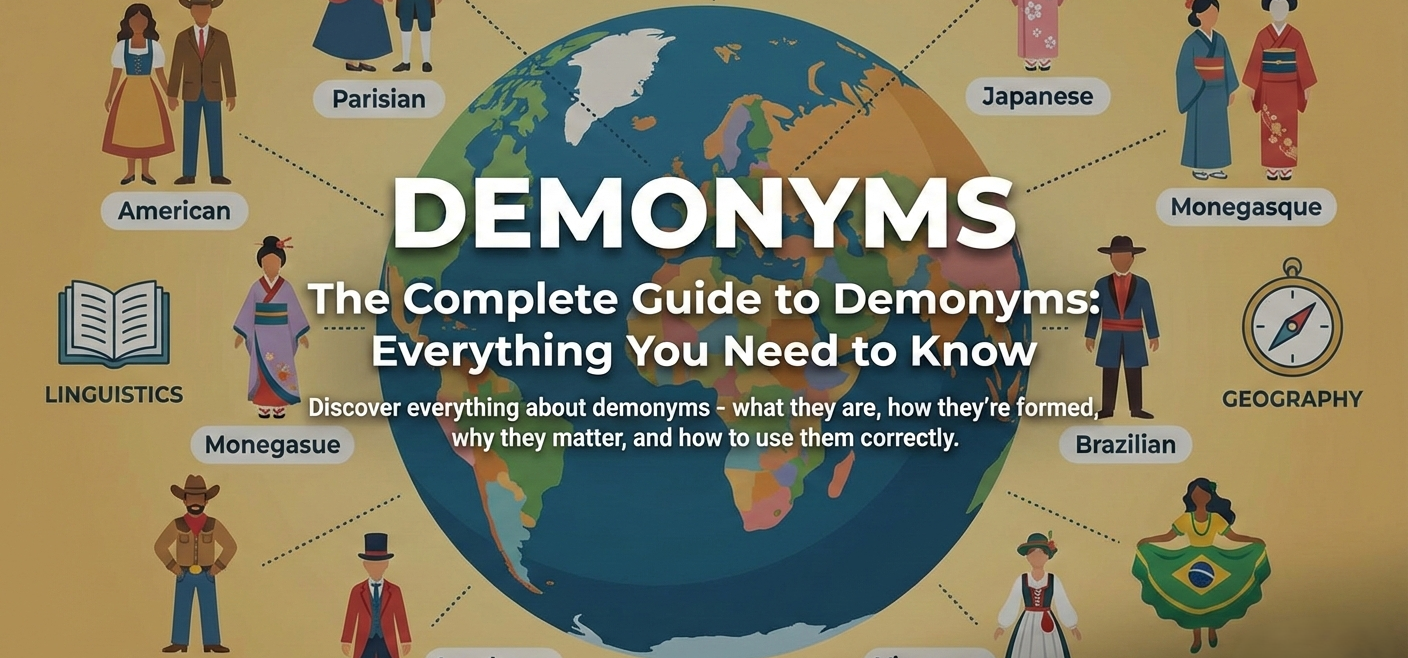
Have you ever wondered what to call someone from Monaco? Or Tokyo? Or even your own hometown? The answer lies in a fascinating aspect of language called demonyms – words that identify people based on where they're from. Whether you're a student studying geography, a writer crafting international stories, or simply curious about language, understanding demonyms opens up a world of linguistic discovery.
In this comprehensive guide, we'll explore everything you need to know about demonyms: their definition, formation rules, cultural significance, and practical usage. By the end, you'll be able to confidently identify and use demonyms for places around the world.
What Is a Demonym? Understanding the Basics
A demonym is a word that identifies a group of people in relation to a particular place. Simply put, it's the term used to describe residents or natives of a specific geographic location – whether that's a country, state, region, or city.
The word "demonym" itself has Greek origins, combining demos (meaning "people") and onyma (meaning "name"). The term was first coined by George H. Scheetz in his 1988 work "Names' Names: A Descriptive and Prescriptive Onymicon," though the concept of naming people by their place of origin is as old as language itself.
Common Examples of Demonyms
To understand demonyms better, let's look at some familiar examples:
- Country demonyms: American (United States), French (France), Japanese (Japan), Brazilian (Brazil)
- State demonyms: Californian (California), Texan (Texas), Floridian (Florida)
- City demonyms: New Yorker, Parisian, Londoner, Torontonian
- Regional demonyms: New Englander (New England), Midwesterner (American Midwest), Scandinavian (Scandinavia)
Demonyms vs. Nationality, Ethnicity, and Citizenship
It's important to distinguish demonyms from related but distinct concepts:
- Demonym: A linguistic term for people from a place (e.g., "Texan" for someone from Texas)
- Nationality: Legal citizenship status (e.g., "American citizen")
- Ethnicity: Cultural or ancestral background (e.g., "Hispanic," "Chinese")
- Citizenship: Legal membership in a country (e.g., "U.S. citizen")
A person can have multiple demonyms (New Yorker, American, New Englander) but typically only one nationality or citizenship. Demonyms are purely geographical identifiers, while nationality involves legal status.
Why Demonyms Matter in Modern Communication
Demonyms might seem like simple labels, but they play a crucial role in how we communicate, identify ourselves, and understand the world around us.
Identity and Cultural Pride
Demonyms are deeply tied to personal and collective identity. When someone says "I'm a New Yorker" or "I'm Parisian," they're not just stating a fact – they're expressing pride, cultural connection, and a sense of belonging. These terms carry connotations about lifestyle, values, and shared experiences.
Consider how "Texan" evokes images of wide-open spaces, independence, and a unique cultural identity, or how "Parisian" conjures sophistication, art, and café culture. Demonyms become shorthand for complex cultural identities.
International Communication and Diplomacy
In our globalized world, demonyms are essential for clear international communication. News reporters, diplomats, and business professionals use demonyms daily to discuss people, policies, and perspectives from different places.
For example: "Americans voted in the election," "Japanese officials announced," or "Brazilian exporters reported." These demonyms provide clarity and brevity in professional communication.
Travel and Tourism
Understanding demonyms enhances travel experiences. Knowing the correct term for locals shows respect and cultural awareness. Saying "I spoke with some Monegasques about their culture" demonstrates more sophistication than "I talked to people from Monaco."
Educational Value
Demonyms are excellent tools for learning geography and language. Students who study demonyms naturally learn about:
- Geographic locations and their relationships
- Language patterns and linguistic rules
- Cultural identities and histories
- Etymology and word formation
Media and Literature
Writers, journalists, and content creators rely on demonyms to create authentic, specific narratives. Instead of writing "a person from Italy," saying "an Italian" is more direct and engaging. Demonyms add precision and authenticity to storytelling.
How Demonyms Are Formed: Linguistic Patterns and Rules
Understanding how demonyms are formed helps you predict unfamiliar ones and appreciate the linguistic creativity behind them. While there are patterns, English demonyms come from multiple language traditions, creating both rules and delightful exceptions.
Common Suffix Patterns
1. The -an Suffix (Most Common – ~40%)
The -an suffix is the most prevalent demonym ending in English, typically used for places with Latin or Romance language origins.
Formation rule: Place name + -an
Examples:
- America → American
- Mexico → Mexican
- Africa → African
- Cuba → Cuban
- Korea → Korean
- Venezuela → Venezuelan
- Alaska → Alaskan
- Montana → Montanan
Usage pattern: This suffix works particularly well with place names ending in vowels, especially -a, -ia, or -o.
2. The -ian Suffix (Second Most Common – ~25%)
The -ian suffix, derived from Latin -ianus via Greek -ianos, is commonly used for European cities and multi-syllable place names.
Formation rule: Place name + -ian (sometimes with phonological modifications)
Examples:
- Boston → Bostonian
- Paris → Parisian
- Norway → Norwegian
- Australia → Australian
- Brazil → Brazilian
- Italy → Italian
- California → Californian
- Virginia → Virginian
Usage pattern: Often used for places ending in consonants or those with historical/academic Latin forms.
3. The -ese Suffix (~10%)
The -ese suffix, from Latin -ensis (meaning "belonging to"), is predominantly used for Asian countries and some European places.
Formation rule: Place name + -ese (often dropping final vowels)
Examples:
- China → Chinese
- Japan → Japanese
- Portugal → Portuguese
- Lebanon → Lebanese
- Sudan → Sudanese
- Vienna → Viennese
- Milan → Milanese
- Congo → Congolese
Usage pattern: Common for Asian nations; sometimes involves stem modification (China loses its 'a').
4. The -ish Suffix (~8%)
The -ish suffix comes from Old English -isc and is particularly associated with the British Isles and some European countries.
Formation rule: Place name + -ish (sometimes dropping -land)
Examples:
- Britain → British
- Ireland → Irish (drops -land)
- Scotland → Scottish (drops -land)
- England → English (drops -land)
- Turkey → Turkish
- Poland → Polish
- Finland → Finnish
- Spain → Spanish
Usage pattern: Often drops "-land" when present; associated with ethnic and national identities in Northwestern Europe.
5. The -er Suffix (~7%)
The -er suffix has Germanic origins and is commonly used for cities, especially those with Germanic influence.
Formation rule: Place name + -er
Examples:
- London → Londoner
- Berlin → Berliner
- New York → New Yorker
- Dublin → Dubliner
- Copenhagen → Copenhagener
- Wellington → Wellingtonian
- Iceland → Icelander
- New Zealand → New Zealander
Usage pattern: Very common for major cities; frequently used for two-word place names (New York, New Jersey, etc.).
6. The -i Suffix (~5%)
The -i suffix reflects Arabic and Persian naming patterns, common in Middle Eastern demonyms.
Formation rule: Place name + -i
Examples:
- Pakistan → Pakistani
- Iraq → Iraqi
- Kuwait → Kuwaiti
- Israel → Israeli
- Saudi Arabia → Saudi
- Bahrain → Bahraini
- Yemeni → Yemeni
- Somali → Somali
Usage pattern: Dominant in Middle Eastern countries; reflects Arabic nisba (attribution) patterns.
7. Less Common Suffixes
-ite (~2%): Often historical or biblical
- Moscow → Muscovite
- Manhattan → Manhattanite
- Israel → Israelite (historical/biblical)
-ois/-ais (~2%): French influence
- Quebec City → Québécois
- Montreal → Montréalais
Zero derivation (~1%): The word itself serves as the demonym
- French (France)
- Dutch (Netherlands)
- Swiss (Switzerland)
Phonological Modifications
When adding suffixes, the base form sometimes changes:
Vowel dropping: If a place name ends in 'a', it's often dropped before adding a suffix
Consonant doubling: Some formations double consonants
- Manhattan → Manhattanite
Stress shifts: Adding a suffix often changes stress patterns
- PAris → PaRIsian (stress shifts to the penultimate syllable)
Silent letter activation: Silent letters in place names may be pronounced in demonyms
- Paris (silent 's') → Parisian (pronounced 's')
Types and Categories of Demonyms
Demonyms can be categorized based on the geographic scale they represent.
National Demonyms
These identify people from countries and are among the most commonly used demonyms:
- United States → American
- Canada → Canadian
- Germany → German
- India → Indian
- Egypt → Egyptian
- Argentina → Argentinian/Argentine
State and Provincial Demonyms
Many countries have specific demonyms for their subdivisions:
- Texas → Texan
- California → Californian
- Ontario → Ontarian
- Bavaria → Bavarian
- Punjab → Punjabi
City Demonyms
Major cities often have distinctive demonyms:
- New York → New Yorker
- Los Angeles → Angeleno
- Chicago → Chicagoan
- San Francisco → San Franciscan
- Sydney → Sydneysider
- Toronto → Torontonian
- Rome → Roman
- Moscow → Muscovite
Regional Demonyms
Broader geographic areas also have demonyms:
- New England → New Englander
- Midwest (USA) → Midwesterner
- Scandinavia → Scandinavian
- Balkans → Balkan
- Caribbean → Caribbean
Historical Demonyms
Some demonyms refer to historical places or periods:
- Ancient Rome → Roman
- Byzantine Empire → Byzantine
- Victorian England → Victorian
- Ottoman Empire → Ottoman
How to Use Demonyms Correctly: Grammar and Style Rules
Capitalization Rules
Always capitalize demonyms. They are proper adjectives derived from proper nouns (place names).
Correct:
- "She is American."
- "They spoke with a French accent."
- "The Brazilian team won."
Incorrect:
- "She is american." ❌
- "They spoke with a french accent." ❌
This rule applies in English; other languages may have different capitalization conventions.
Plural Forms
Most demonyms form plurals by adding -s:
- American → Americans
- Mexican → Mexicans
- Parisian → Parisians
- New Yorker → New Yorkers
Exception: Some demonyms remain unchanged in plural:
- French → French (not "Frenches")
- Dutch → Dutch
- Swiss → Swiss
- Chinese → Chinese
- Japanese → Japanese
Using Demonyms as Adjectives and Nouns
Demonyms function as both adjectives and nouns:
As adjectives (modifying nouns):
- "American culture is diverse."
- "We visited a French restaurant."
- "She studies Chinese history."
As nouns (naming people):
- "He is an American."
- "Many French live in Paris."
- "The Japanese have a rich cultural heritage."
When to Use Demonyms
Appropriate contexts:
- Formal writing and academic papers
- News articles and journalism
- Geographic and cultural discussions
- Professional communication
- Describing cultural products (French wine, Italian art)
Consider alternatives when:
- Discussing sensitive political situations
- Avoiding generalizations or stereotypes
- Emphasizing individual identity over group membership
- Legal contexts requiring precise citizenship terminology
Style Guide Considerations
Different style guides have specific rules:
AP Style:
- Capitalize demonyms
- Use "the" sparingly with plural demonyms ("Chinese officials" not "the Chinese officials")
Chicago Manual of Style:
- Capitalize all demonyms
- Be consistent with plural vs. singular usage
Academic Writing:
- Use demonyms precisely
- Distinguish between ethnicity, nationality, and geographic origin when relevant
Famous and Unusual Demonyms Around the World
Some demonyms stand out for their unique formations or interesting histories.
Liverpudlian (Liverpool, UK)
Perhaps the most famous unusual demonym, "Liverpudlian" combines Liverpool with the -ian suffix, but includes a playful "pudl" adaptation of "pool." This quirky term reflects Liverpool's working-class humor and cultural distinctiveness. Liverpudlians embrace this demonym with pride, especially given the city's global cultural influence through The Beatles and its maritime heritage.
Monegasque (Monaco)
"Monegasque" comes from "Munegu," the Ligurian dialect name for Monaco, with the French -asque suffix. This demonym reflects Monaco's unique position between French and Italian cultures. With only about 9,000 native Monegasques among Monaco's 39,000 residents, the term represents a precious and carefully guarded cultural identity.
Mancunian (Manchester, UK)
"Mancunian" derives directly from "Mamucium" or "Mancunium," the Roman name for Manchester established around 79 CE. This demonym carries Manchester's industrial heritage – the city was the world's first industrialized city and birthplace of the Industrial Revolution. Being Mancunian means being part of this transformative history.
Haligonian (Halifax, Nova Scotia, Canada)
From "Haligonia," the Latinized form of Halifax, this demonym preserves academic naming traditions in the New World. Halifax's maritime heritage and role as a major Atlantic port make "Haligonian" a badge of nautical pride.
Varsovian (Warsaw, Poland)
From Latin "Varsovia," this demonym carries special significance. Warsaw was 85% destroyed in World War II and subsequently rebuilt, making "Varsovian" a symbol of resilience and cultural preservation against tremendous odds.
Novocastrian (Newcastle)
From Latin "Novum Castrum" (meaning "new castle"), "Novocastrian" is used for multiple cities named Newcastle worldwide (UK, Australia, etc.). This scholarly coinage demonstrates how Latin continues to influence English demonym formation.
Glaswegian (Glasgow, Scotland)
"Glaswegian" features an unusual -wegian suffix, where "weg" reflects the Gaelic word for "place of." This distinctive formation sets Glaswegians apart and reflects Scottish cultural pride and linguistic heritage.
Learning and Remembering Demonyms: Practical Tips
Pattern Recognition
Focus on identifying common suffixes (-an, -ian, -ese, -ish, -er, -i) and their typical usage patterns. Once you recognize these patterns, you can predict many demonyms with 80-85% accuracy.
Association Techniques
Create mental connections:
- Link the demonym to cultural elements: "Parisian" → Eiffel Tower → sophisticated fashion
- Use memorable phrases: "New Yorkers are fast-walkers"
- Connect to famous people: "Einstein was German"
Etymology Study
Understanding word origins helps retention:
- "Canadian" comes from "Kanata" (Iroquois for "village")
- "American" relates to explorer Amerigo Vespucci
- "Irish" reflects Old English "Īrisc"
Practice with Quizzes
Regular testing reinforces learning. Try our interactive demonym quizzes to test your knowledge and track your progress. Start with familiar places and gradually add more challenging ones.
Memory Palace Method
For serious students, the memory palace technique works well:
- Visualize a familiar location (your home, school, neighborhood)
- Place demonyms at specific spots
- Create vivid mental images connecting the spot to the demonym
- Mentally walk through your palace to recall
Regular Exposure
Read international news, travel blogs, and geographic content. The more you encounter demonyms in context, the more naturally they'll stick.
Use Flashcards
Create physical or digital flashcards:
- Front: Place name + flag/image
- Back: Demonym + pronunciation + interesting fact
Demonyms in Different Languages
While this guide focuses on English, it's fascinating to see how other languages form demonyms.
Spanish Patterns
Spanish typically uses:
- -ano: mexicano, cubano, americano
- -eño: madrileño, limeño, brasileño
- -és: francés, portugués, inglés
French Patterns
French commonly uses:
- -ain/-ien: américain, italien, canadien
- -ais/-ois: français, anglais, québécois
- -and: allemand (German)
German Patterns
German typically uses:
- -er: Amerikaner, Berliner, Münchner, Schweizer
- -isch (adjective form): amerikanisch, deutsch
Japanese Patterns
Japanese uses:
- -jin (人): アメリカ人 (amerikajin), 日本人 (nihonjin), フランス人 (furansujin)
- The character 人 (jin/nin) literally means "person"
Arabic Patterns
Arabic uses the nisba pattern:
- -i suffix: مصري (Egyptian - Misri), سوري (Syrian - Suri), عراقي (Iraqi - 'Iraqi)
Understanding these patterns helps when reading international news or communicating across languages.
Advanced Topics: Demonyms and Linguistic Change
How Demonyms Evolve Over Time
Languages change, and demonyms change with them. Some historical examples:
Political changes: When Bombay became Mumbai (officially in 1995), "Bombayite" slowly gave way to "Mumbaikar" or "Mumbaiite," though both remain in use.
Decolonization: Many places adopted or returned to indigenous names and demonyms post-independence, such as "Sri Lankan" (replacing "Ceylonese").
Standardization: Mass media and education have standardized many demonyms that previously had multiple competing forms.
Multiple Acceptable Demonyms
Some places have more than one accepted demonym:
- Netherlands: Dutch (most common), Netherlanders, Hollanders (regional)
- United Kingdom: British, Briton, Brit (informal)
- Argentina: Argentinian, Argentine (both accepted)
- Monaco: Monegasque, Monacan (less common)
Context, formality, and regional preference determine which form is used.
Demonyms in Academic and Scientific Contexts
In scholarly work, precision matters:
- Distinguish between ethnic, national, and geographic identities
- Use demonyms consistently throughout a work
- Be aware of political sensitivities (e.g., "Palestinian" vs. "Israeli" in contested regions)
- Cite sources when discussing historical or disputed demonyms
Demonyms and Cultural Sensitivity
Respectful Usage
Best practices:
- Use the demonym that locals prefer
- Avoid stereotyping based on demonyms
- Recognize that demonyms describe geography, not personality
- Be aware of political sensitivities in contested regions
Problematic usage to avoid:
- Using demonyms to generalize: "Americans are..." (too broad)
- Historical offensive terms (many exist; use modern, accepted terms)
- Assuming homogeneity: "The French think..." (overgeneralization)
Controversial and Changing Demonyms
Some demonyms are contested or evolving:
- Historical terms that are now offensive (consult current usage guides)
- Terms affected by political disputes
- Regional variations in preferred demonyms
When in doubt, ask locals or consult recent, authoritative sources.
Conclusion: The Rich World of Demonyms
Demonyms are far more than simple labels for people from places. They're linguistic artifacts that carry history, culture, and identity. From the straightforward "American" to the quirky "Liverpudlian," each demonym tells a story about language evolution, cultural pride, and human connection to place.
Whether you're a student mastering geography, a writer seeking authenticity, a traveler showing respect, or simply a language enthusiast, understanding demonyms enriches your communication and deepens your appreciation for the world's diverse places and peoples.
Ready to explore more? Browse our comprehensive database of 500+ demonyms organized by region, or test your knowledge with our interactive quizzes. Each place has a story, and every demonym is a gateway to discovering it.
Frequently Asked Questions
What is the difference between a demonym and a nationality?
Why do some places have unusual demonyms like 'Liverpudlian' or 'Monegasque'?
Are demonyms always capitalized in English?
How do I know which suffix to use when forming a demonym?
Can demonyms change over time?
Sources and Further Reading
-
Scheetz, George H. (1988). "Names' Names: A Descriptive and Prescriptive Onymicon" - The foundational work that coined the term "demonym"
-
Merriam-Webster Dictionary. "Demonym." Definition and usage guide. https://www.merriam-webster.com/dictionary/demonym
-
Oxford English Dictionary. "Demonym" entry and related terms. Oxford University Press.
-
Wikipedia Contributors. "Demonym." Wikipedia, The Free Encyclopedia. https://en.wikipedia.org/wiki/Demonym
-
Crystal, David. "The Cambridge Encyclopedia of the English Language." Cambridge University Press, 2003.
-
Bauer, Laurie. "English Word-Formation." Cambridge University Press, 1983.
-
"The Chicago Manual of Style," 17th edition. University of Chicago Press, 2017.
-
AP Stylebook Online. Geographic names and demonym usage guidelines. Associated Press.
-
Britannica. "Nationality and Geographic Terms." Encyclopedia Britannica. https://www.britannica.com
-
Ethnologue: Languages of the World. SIL International. Resources on global naming conventions.