From Mishigami to Michigan: The Erosion of Indigenous Names
How did Ojibwe 'Mishigami' become Michigan? Trace the phonetic erosion of Indigenous place names, and what each worn-smooth word still hides.
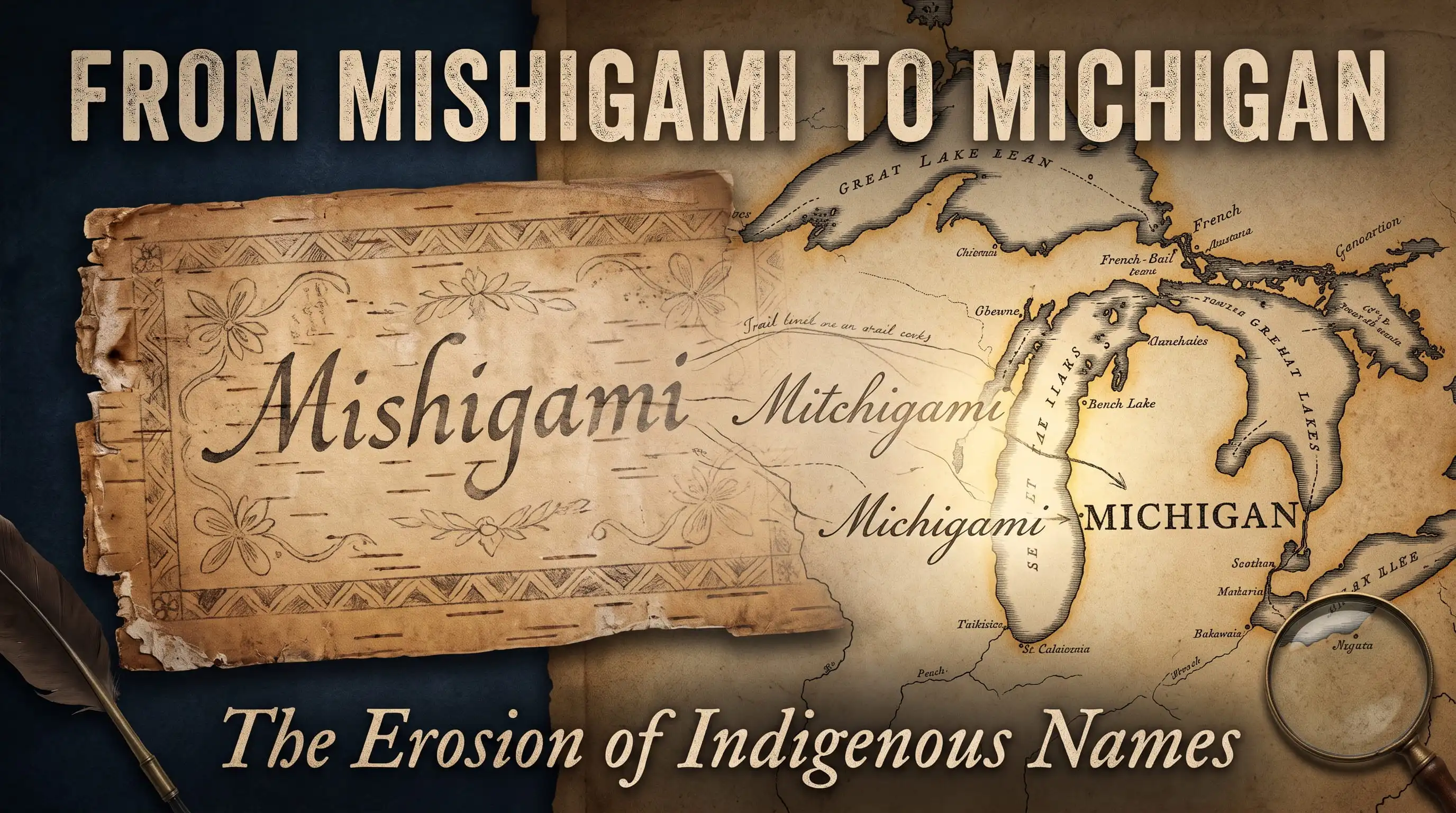
Why Mishigami Became Michigan: The Short Answer
The Ojibwe word mishigami, usually translated as "great water" or "large lake," names a place before the place had a European name. English "Michigan" is that same word, re-spelled: it arrived through French colonial orthography and the fur-trade maps of the 17th century, each copyist nudging the spelling a little closer to French and then English habits.
Phonetic erosion is the gradual wearing-down of a borrowed name as each new language substitutes familiar sounds, drops unstressed syllables, and re-spells what it hears.
Three forces do most of the work, and you will meet all of them again in the pages ahead:
- Sound substitution, where a foreign consonant is swapped for the nearest comfortable one, as when Ojibwe misi-ziibi surfaces in English as Mississippi.
- Vowel reduction and syllable loss, where unstressed syllables thin out and vanish, as in Mohegan quinnitukqut becoming Connecticut.
- Clerkly respelling, where a mapmaker writes down what he thinks he hears, as with French Ouisconsin settling into Wisconsin.
Michigan is simply the best-documented case of all three acting at once, and we will trace it segment by segment. Stay for the sound-by-sound breakdown, where mishigami is slowly taken apart and put back together as the state name you know.
How Phonetic Erosion Works: Five Forces That Wore Names Smooth
-
Phoneme substitution: sounds that don't exist in the borrowing language get replaced by the nearest available ones. English has no easy equivalent for Ojibwe long vowels or nasalized vowels, so speakers reach for shorter, oral substitutes. The stretched and nasal quality that carried meaning in the source language simply flattens out. Compare how French nuit lands in English as night, with the vowel pulled toward a familiar English shape.
-
Vowel reduction: unstressed vowels collapse toward schwa, the neutral murmur at the center of English speech. In Massachusett massa-adchu-es-et, three distinct unstressed syllables each hold their own vowel. English rhythm grinds them down until only Massachusetts remains, with its middle vowels worn to a blur. The same erosion turns Spanish palacio into English palace in casual speech.
-
Consonant cluster simplification: clusters and doubled consonants thin out because they slow the borrowing tongue. Mohegan quinnitukqut carries doubled consonants that English mouths rarely sustain. By the time the word settles, those clusters have smoothed into Connecticut, where the double n survives but the rest has been pared back. English does the same to Greek pneuma, pronounced simply as pneuma with a silent p.
-
Orthographic adaptation: scribes reshape a spoken word to fit their own spelling conventions. French writers used ou for the /u/ sound and ch for /sh/, so what they heard as Ouisconsin reached English pages already wearing French clothing, emerging as Wisconsin. Michilimackinac kept that French shape long after the language that produced it stopped being the region's lingua franca. The same habit gives us French chambre becoming English chamber in older texts.
-
Apocope and analogical reshaping: final syllables drop, or the whole word bends to resemble a familiar English ending. Miwok Yohhe'meti lost its tail and gained a suffix that looked comfortably American, arriving as Yosemite. Speakers reach for a shape they already know, and the unfamiliar original pays the price. This is how Latin dominicum survives only as dome in everyday English.
These forces rarely act alone. A single name can show three or four at once, layered over centuries of transcription, translation, and casual repetition, which is why the path from "Mishigami" to Michigan: the phonetic erosion of indigenous names is rarely a straight line.
Mishigami to Michigan, Sound by Sound
The source form is mishigami, a word French colonial records also spelled mitchigami and michigami. Its Ojibwe morphemes are mi-, a prefix meaning "great" or "big," and gami, a root for "water" or "lake." Watch what happens as the word crosses into English.
| Ojibwe element | Result in English | What happened |
|---|---|---|
| mi- (long i) | Mi- (short i) | Vowel shortening |
| shi- (/sh/) | -shi- (/sh/) | The sound survived intact because English already had /sh/ |
| gami (water, lake) | -gan | Loss of the final vowel and the puzzling drift of m to n |
| final -n | -n | An unexplained consonant with no source in mishigami |
The honest scholarly caveat concerns that last row. The final -n is usually explained by the Ojibwe locative form mishigamiing, meaning "at the great water," which supplies the nasal where mishigami alone does not. Some writers instead split the word as michi plus gami and treat the compound as a Chippewa phrase for "great lake." Either way, the English spelling settles on Michigan. Meanwhile, French maps were busy with a different label altogether: Lac des Puants, the name they used for what is now Lake Michigan. The lake carried the name Michigan long before the territory or the state did, which is why the state inherited it rather than bestowed it.
Six More Indigenous Names Worn Smooth by English
Michigan is not exceptional. It is simply the most visible instance of a habit that shaped nearly every place-name east of the Mississippi.
| Source word and language | Modern English name | Erosion at work |
|---|---|---|
| massa-adchu-es-et (Massachusett) | Massachusetts | cluster trimming plus vowel reduction |
| manahatta (Lenape) | Manhattan | unstressed syllables leveled |
| quinnitukqut (Mohegan-Pequot) | Connecticut | doubled consonants simplified |
| shikaakwa (Miami-Illinois) | Chicago | vowel shortening and re-spelling |
| Mahnawaukee-Seepe (Potawatomi) | Milwaukee | compound clipped to its first element |
| misi-ziibi (Ojibwe) | Mississippi | geminate consonants and long vowels flattened |
Connecticut is the most instructive of the six. Its source, quinnitukqut, translates as "beside the long tidal river," and the English spelling keeps the original four syllables intact: Con-nec-ti-cut. What it does not keep is the consonant framework. The doubled nn survives only because English tolerates it, while the final kt sound arrives on the page as ct, so the mouth reads one thing and the eye another.
Manhattan fares better in memory than in accuracy. The usual translation of manahatta is "island of many hills," a description any walker of the island's ridgelines would recognize. The popular alternative gloss, "place of general inebriation," is a disputed folk etymology, an invented story that circulated because it sounded amusing and has been repeated ever since.
Chicago hides its meaning best of all. Shikaakwa refers to a plant, Allium tricoccum, known today as ramps or wild leeks, and its sense is "striped skunk," a description of the bulb's mottled skin. The reading of the name as a reference to the skunk animal is a later confusion, and it has stuck so firmly that few residents connect their city to a spring vegetable.
The French Filter: Why Some Names Kept Their Shape
French missionaries and cartographers were the first Europeans to write these names down, and their spelling habits travelled with them. French renders the /u/ sound as ou, so early maps show Ouisconsin. When English printers took over the plates, the opening O dropped away and Wisconsin remained, carrying a French vowel convention into an English mouth.
ch standing for /sh/
French ch is pronounced /sh/, which is the reason Michilimackinac begins the way it does. The name comes from Ojibwe mishinii-makinaak, "big turtle." English inherited the French transcription rather than the Ojibwe sound, then gradually trimmed the compound down to the Mackinac forms used today.
Silent finals and nasal vowels
French also leaves final consonants unvoiced and folds vowels into nasals, and English kept both habits. Illinois descends from iliniwek, and the trailing s in the French spelling is never pronounced: three syllables, a soft ending, an Indigenous word wearing French clothing.
The Jesuit Relations, the 17th-century missionary reports, remain the earliest written record for dozens of these names, and their French spellings are precisely why English speakers say Michigan and not Mishigami. English colonists arriving later had no French model to follow and respelled by ear instead, giving us Yosemite from Miwok and Tacoma from Lushootseed teqWubeh. French mediation could also rename a people entirely: Sioux is a French shortening of Ojibwe naadowesiwag, "little snakes." For the terminology that separates such borrowed labels from the names communities use for themselves, see our guide to the difference between exonyms and endonyms.
When Erosion Invites Myth: Folk Etymologies and Invented Names
-
"Idaho is a Shoshone word meaning gem of the mountains." The name was coined around 1860, plausibly by Washington lobbyist George M. Willing, who presented it to Congress as an indigenous term for a proposed territory. No such Shoshone word exists, and the "gem of the mountains" gloss was attached later to flatter the new territory's mining economy.
-
"Michigan means land of the great lake." The Ojibwe source term describes great water or a large lake, referring to the body of water itself rather than to any territory. The "land of" phrasing is a modern English gloss with no basis in the word's morphology, a pattern of expansion that turns a noun into a slogan.
-
"Wyoming is definitively Lenape for at the big river flat." The Lenape derivation xwewamank is the leading account, but scholars still debate it against competing Munsee forms and early English colonial uses of the word for other places. Calling the meaning settled overstates what the evidence supports.
-
"Chicago means place of the skunk." The established reading points to a wild-leek plant, as noted earlier, and the animal sense is a back-formation built from the modern city's reputation rather than from the source language.
Heavy erosion is precisely the condition in which folk etymology thrives: when a word's surface has been worn smooth, a satisfying story slides in to fill the gap. Our own debunking of the "Hill Hill Hill Hill" claim about Torpenhow Hill makes the same point in miniature, showing how a tidy chain of repeated names can outrun the evidence entirely.
What Erosion Teaches Us About Naming (and Demonyms)
Ojibwe is not a museum piece. It is a living language spoken today by tens of thousands of people across the Great Lakes region, which means mishigami is a current word rather than a dead curiosity: someone can say it this afternoon and be understood. Style guides have caught up with that reality, increasingly favoring endonyms and capitalizing language names as proper nouns, a small typographic courtesy that keeps indigenous vocabulary visible instead of quietly folded into English.
Demonyms, though, are rebuilt from the eroded form, never the original. Nobody derives a resident's label from mishigami; writers reach for the shortened, anglicized shape printed on the map. That is why we say Michigander and Michiganian rather than anything traced back to the Ojibwe.
Those demonyms, in turn, are themselves contested, with residents arguing over which label sounds right:
- Michigander — popularized in 1848 by Abraham Lincoln, who used it while mocking Lewis Cass, and it has carried a slightly playful, homegrown flavor ever since.
- Michiganian — the more formal-sounding rival, favored by newspapers and institutions that want a straightforward -ian construction.
- Chicagoan — a clean application of the productive -an suffix, though locals still split over whether Chicagoan or Chicagoite belongs in print.
- Manhattanite — one of several competing labels for New York City residents, sharpened by the -ite ending that marks borough-level identity.
Browse our demonym database to settle the next argument before it starts, and pair it with our recommended world atlases and style guides for anyone who wants to get place names right.