Demonyms with the Strongest Origins
Explore the fascinating etymology behind some of the world's most interesting demonyms and their historical roots.
Demonyms are more than just labels for people from different places, they are linguistic time capsules that reveal fascinating stories about history, culture, and identity. In this article, we'll explore some of the most intriguing demonyms with the strongest origins that tell remarkable tales of the past.
What Makes a Demonym's Origin "Strong"?
A demonym's origin is considered strong when it has clear historical roots, tells a compelling story, or preserves ancient linguistic features that have survived through centuries. These aren't just random names, they are windows into our collective past.
Liverpudlians: The People of Liverpool
The term "Liverpudlian" for residents of Liverpool, England, is one of the most colorful demonyms in the English language. While it might sound like it has something to do with puddles, the truth is even more interesting.
The name comes from combining "Liverpool" with the suffix "-ian," but the "pudl" part is a humorous adaptation of "pool" in the city's name. Liverpool itself means "pool or creek with muddy water" in Old English, and over time, the locals embraced this playful demonym that perfectly captures the city's wit and character.
Historical Significance
Liverpool rose to prominence as a major port city during the Industrial Revolution. The demonym "Liverpudlian" emerged in the 19th century and has since become a badge of pride for the city's residents, particularly during Liverpool's cultural renaissance in the 1960s with the rise of The Beatles.
Cantabrigians: The Scholars of Cambridge
"Cantabrigian" refers to people from Cambridge, England, particularly those associated with Cambridge University. This demonym has Latin roots that stretch back to Roman Britain.
The name comes from "Cantabrigia," the medieval Latin name for Cambridge. The Romans originally knew the settlement as "Duroliponte," but by the medieval period, scholars had Latinized the Anglo-Saxon name "Grantebrycge" (bridge over the River Granta) into the more elegant "Cantabrigia."
Academic Heritage
The demonym carries special significance in academic circles. Being called a Cantabrigian often implies not just geographical origin but also association with one of the world's oldest and most prestigious universities, founded in 1209.
Monegasques: The Citizens of Monaco
The residents of Monaco are known as "Monegasques" (or Monégasques in French), a demonym that reflects the principality's unique cultural identity and Italian-French linguistic heritage.
The term comes from "Munegu," the Ligurian dialect name for Monaco. This connection to the Ligurian language, spoken in nearby regions of Italy, reflects Monaco's historical ties to Genoa and the medieval House of Grimaldi, which still rules the principality today.
Cultural Preservation
With only about 9,000 native Monegasques among Monaco's 39,000 residents, the demonym represents more than just origin, it signifies a unique status in this tiny sovereign nation where citizenship is precious and cultural identity is carefully preserved.
Mancunians: The Heart of Industrial England
Residents of Manchester, England, are called "Mancunians," a demonym with ancient Roman origins. The name derives from "Mamucium," the Roman fort established on the site around 79 CE.
The Latin suffix "-ium" was common for Roman settlements, and "Mamucium" possibly referred to a "breast-shaped hill" in Celtic. Over centuries, Mamucium evolved into "Mancunium" in medieval Latin, eventually giving us the modern "Manchester" and its residents, the "Mancunians."
Industrial Revolution Legacy
Manchester was the world's first industrialized city and the birthplace of the Industrial Revolution. The demonym "Mancunian" carries echoes of this transformative period, representing a city that changed the world through innovation, from textile manufacturing to modern computing.
Haligonians: The People of Halifax
Residents of Halifax, Nova Scotia, Canada, are called "Haligonians," a demonym that beautifully preserves Latin academic traditions in the New World.
"Haligonian" comes from "Haligonia," the Latinized form of Halifax. This practice of creating Latin versions of place names was common in British colonial times, especially among educated elites. The name Halifax itself possibly derives from "holy flax" in Old English, referring to religious land used for growing flax.
Maritime Heritage
Founded in 1749, Halifax played a crucial role in British naval operations in North America. Haligonians take pride in their maritime heritage, and the city remains one of Canada's most important Atlantic ports. The demonym connects modern residents to this rich naval and mercantile history.
Varsovians: The Phoenix City
The people of Warsaw, Poland, are known as "Varsovians," from the Latin name "Varsovia." This demonym is particularly poignant given the city's history of destruction and rebirth.
Warsaw's Polish name "Warszawa" has uncertain origins. One legend claims it comes from the names Wars and Sawa, a fisherman and mermaid from local folklore. The mermaid remains the city's symbol. The Latinized "Varsovia" gave rise to the English demonym "Varsovian."
Symbol of Resilience
Warsaw was almost completely destroyed during World War II, about 85% of the city lay in ruins by 1945. The reconstruction of Warsaw and the resilience of its people made "Varsovian" a demonym that carries deep historical weight, symbolizing survival and cultural preservation against tremendous odds.
Why Demonym Origins Matter
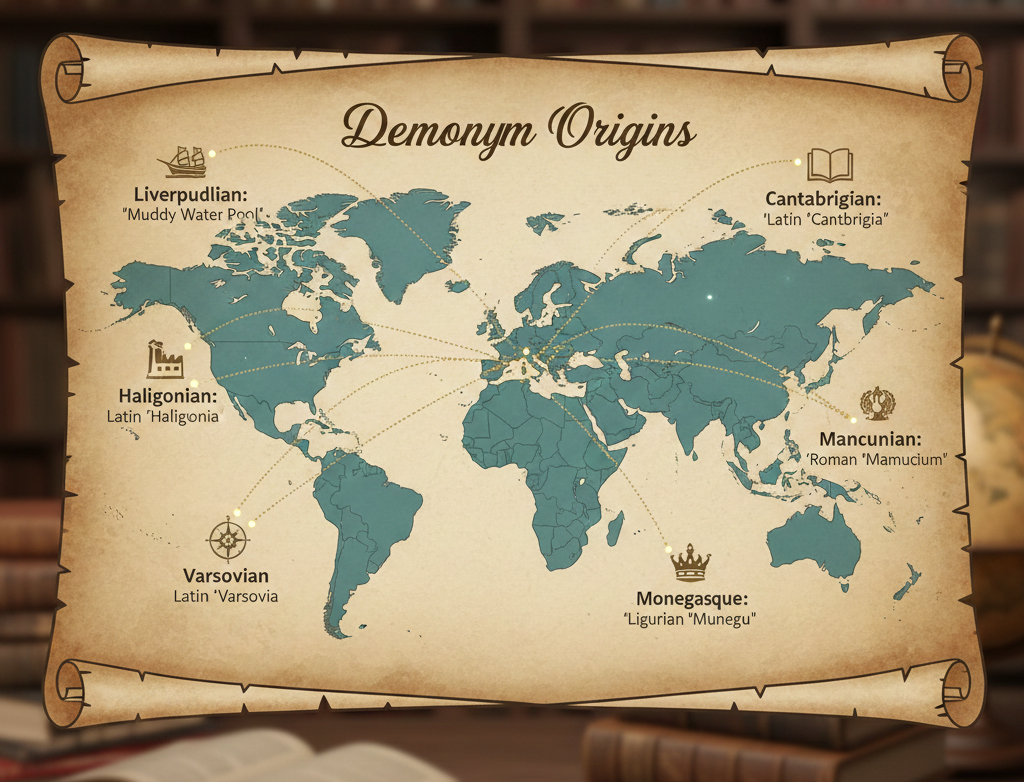
Understanding where demonyms come from helps us appreciate the rich tapestry of human history. Each demonym is a thread connecting present-day residents to their ancestors, preserving linguistic features from Latin, Celtic, Germanic, and other ancient languages.
These names remind us that language is living history. Every time we use terms like "Liverpudlian," "Cantabrigian," or "Varsovian," we're participating in a tradition that spans centuries, keeping alive the stories, cultures, and identities of communities around the world.
Conclusion: The Enduring Power of a Name
From the industrial heart of Manchester to the academic halls of Cambridge, demonyms are far more than just names. They are echoes of history, markers of cultural identity, and a testament to the resilience of communities. As we've seen, a name like "Varsovian" can symbolize the rebirth of a city, while "Monegasque" can signify a precious and preserved heritage. These names connect us to the past and enrich our understanding of the world's diverse places and peoples.